Advertise
Reach German  ecision-makers in their own language
Read by Joël himself, cut firmly into the episode – and so present everywhere the episode runs. In front of an audience where four in five answer for a budget.

The market
Germany listens in German
Germany is the largest economy in Europe and one of the largest podcast markets in the world – but it is not an English-speaking one. Business audiences here listen in German, and advertising that arrives in English is heard as advertising from somewhere else. That is the gap we close: your message, in the language and the tone your buyers actually use.
What digital kompakt is
A German business podcast since 2015, hosted by Joël Kaczmarek. More than 800 published episodes, three episodes a week at most, across three strands: business, personal development and health. Guests are founders, board members and investors of German companies – the same people your sales team is trying to reach.
Who is listening
A B2B audience with more than 60 % decision-makers. People who choose a podcast about business models and growth are not listening on the side – they are listening because it is their job. That is why an ad in this environment is heard rather than skipped.
Why it works from abroad
You do not need a German office, a German agency or a German copywriter. You send us a brief in English. Joël writes and records the spot in German, in his own voice, and it runs in the episodes that fit your audience.

What our  lients say
#Intensity
We love digital kompakt for the way it approaches topics. And the business audience of senior leaders converts directly into customers for us.
 Nadine Müller
sevDesk
#Targeting
digital kompakt reaches decision-makers at every level, and the different formats even let you target industry and focus precisely.
 Jasmin Stemig
PAYBACK
#Attention
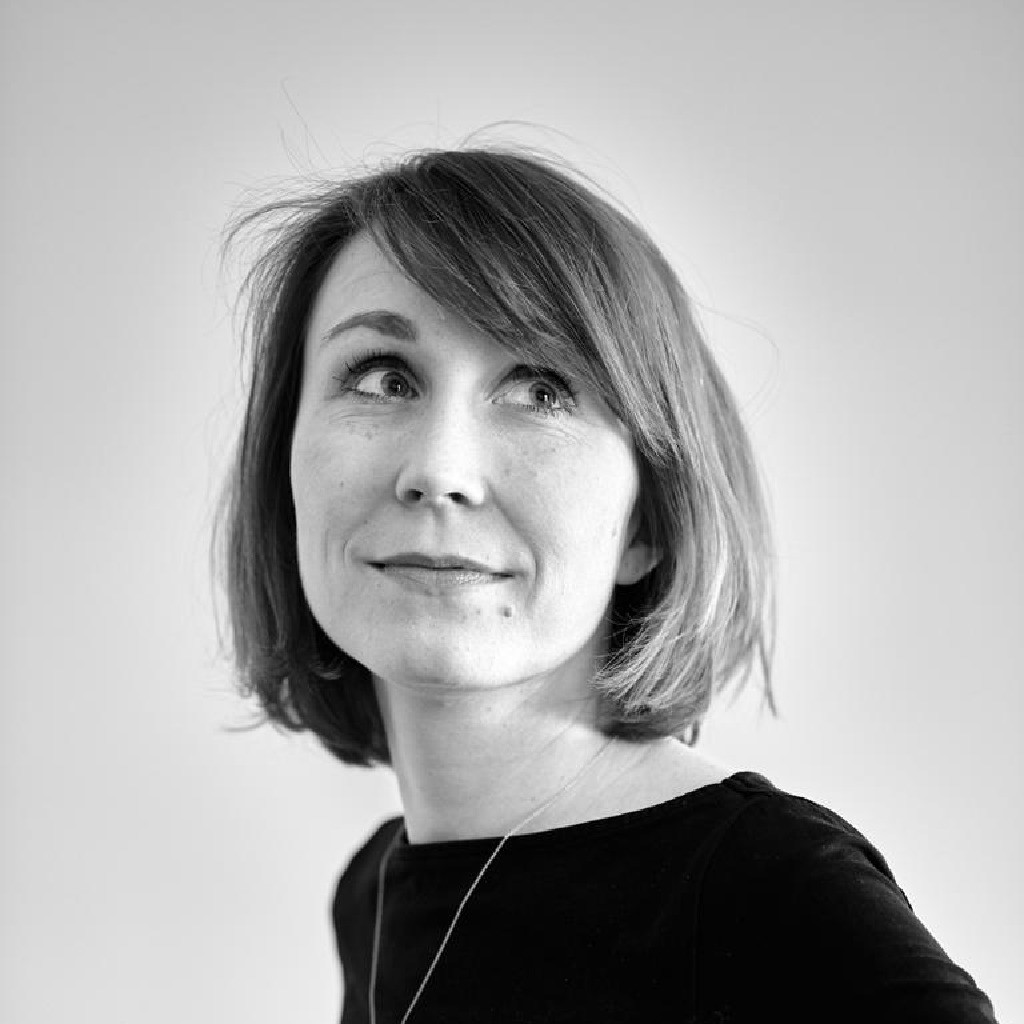
What we like about podcast advertising is the attention you get when your message sits in the right context. You stay in people’s minds and are more likely to be googled.
 Katharina Kremming
Synch
Brands that have advertised with us

Where our podcasts appear


The environment
Our focus
Our guests are the most relevant minds in business and entrepreneurship, alongside experts in their field and people with a story you will not hear anywhere else. Money Monday covers growth and business, Wisdom Wednesday personality and leadership, Feelgood Friday health. Who listens stays the same throughout – a high-quality business audience. Episodes usually run 40 to 60 minutes, with up to four people in the room. All episodes are in German.
Media kit
Who listens, in four figures
- 44,000+subscribers across all channels
- 3,000+decision-makers hear every new episode
- 54.7%of an episode is actually listened to
- 83.8%hold budget responsibility


How it works
What our podcast ads l ok like
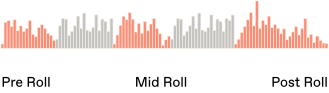
Four steps, none of which require you to speak German. Spots are host-read: Joël introduces you in his own words rather than reading a script at the audience. There are two places in an episode: the pre-roll at the start, before the conversation begins, and the mid-roll in the middle of it. We do not offer a post-roll at the end – it reaches the fewest people and would be the worst deal for you.
- 01
You brief us in English
What you sell, who should hear it, what the listener should do next. A page is enough – you do not need a German script.
- 02
We write and record in German
Joël turns the brief into a spot in his own voice and sends it to you for approval. If the tone is off, we change it before anything airs.
- 03
We place it where it fits
We build the spot permanently into the episodes we agree on – picked by format and topic, not scattered across the whole archive. Since every episode is also produced as video, your ad runs in the video too.
- 04
You get the numbers
You get the reach: how often your spot was played. Billing is in euros; for businesses inside the EU we invoice without VAT under the reverse-charge rule.

Two examples from running campaigns

Regular production
Joël reads the ad himself, in one shot and without cuts – exactly as you see him in the episode. He says what you do and puts it in his own words. Around 40 to 60 seconds.
This is the standard form. It is part of every package.
Premium production
The same read, but cut and animated. Something happens between the statements: overlays, cuts, movement – the eye stays on it a little longer.
More work in production. The difference shows where people watch – on YouTube and in the video apps.
Enquiry
Put together what you need
Pick a package, or start from your budget or the reach you want. You are not committing to anything – what you choose here is the starting point for our conversation, and we say so when something smaller would do.
- Total price incl. add-ons
- Ad impressionsHow often your ad is expected to be played – a planning figure for the whole package.
- SavingHow much less the package costs than the same placements booked one by one.
- Mix
- Ad versionsHow many different versions of your spot the package includes. Each puts something else in the foreground – an argument, a use case, an audience.
- CPMCost per mille: the price of 1,000 ad impressions. Package price divided by ad impressions, times 1,000.
- Price per slotPackage price divided by the number of placements. The larger the package, the cheaper each single slot.
Drag the black dot or click a package to compare.
+ Extras
Received. Thank you.
A copy of your request is in your inbox. We will come back with a concrete proposal – usually within 36 hours.
FAQ
Frequently asked questions
From production and ad formats through to billing. Pick the area you are interested in.
Is the advertising produced as audio or video?
Essentially both. We record the podcast advertising as video, and whether someone consumes an episode as video on YouTube or Spotify, for example, or only as the audio version in a podcast app, they get the advertising either way.
What are Pre-Roll, Mid-Roll and Post-Roll, and which of them is best?
These are the advertising positions within a podcast: Pre-Roll is an ad at the start of the podcast, Mid-Roll in the middle and Post-Roll at the end. digital kompakt offers Pre-Roll and Mid-Roll.
Which of them works best depends somewhat on your own strategy: the Pre-Roll reaches the most listeners, while attention is higher in the Mid-Roll. We recommend a mix of the different positions in order to reach listeners at different points.
Who records the ad: the host or the client?
Our advertising is “Host-read”, which means it is recorded by digital kompakt founder Joël Kaczmarek. That is an advantage for several reasons at once: the advertising comes across as very native, Joël’s credibility rubs off on the content, and at the same time you have hardly any work to do on producing the ad material. Win-win.
What does podcast advertising cost?
A pre-roll ad costs €1,000 with us, a mid-roll ad €750, each net. On top of that there are packages – the more placements, the cheaper the single slot. With the largest package you save a third compared with booking single slots. Prices, packages and a configurator are here.
Included in this price are the coordination of the advertising, the production of the ad spots, one round of revisions and a report.
What does the process look like?
We receive a briefing from you (here is our template for it) explaining how the product should be presented (pronunciation, USPs, landing page and so on). We then write a spot and record it.
You can of course review the advertising beforehand and have revisions made if you wish. After that we agree the publication dates and the targeting, and go into publication.
How long do you need to produce the advertising?
Experience shows that a production window of two weeks works best for everyone involved. We are also able to produce faster.
The next step is to check the availability of the ad slots, and how quickly we can run them. As a rule this is possible within three to four weeks, sometimes faster.
Does the advertising appear in all episodes or only in one?
An ad is built permanently into one episode – this is called “baked-in” and with video advertising it is not possible any other way. The advertising therefore appears in the current episodes and picks up a large reach with them.
How long is a podcast ad?
Our ad spots are usually around 40 to 60 seconds long. Our credo: better concise and relevant than long and uninteresting. Our overriding aim is for the target group actually to listen to the advertising.
Can I filter by target group or topic?
That is possible with us by choosing a topic focus. We have certain recurring content areas, for example leadership, artificial intelligence or success stories, and these reach particular audiences somewhat more precisely. Leadership topics, for instance, are consumed more often by managers.
What does the premium production of the advertising offer?
In the premium production the video is enhanced with cuts and animations. There is more movement in it, which holds the target group’s attention better. In the regular version, by contrast, there is only one perspective, with the story told straight to camera.
You add the premium production to your package: €750 per ad version, net.
You can see both versions further up this page.
What do I need to supply?
The effort is as small as it gets: simply put together a briefing. For that we need the key information about the product (USPs, pronunciation, landing page and so on), the desired targeting (audience) and the contact person for the cooperation. A suggested wording for the podcast ad is particularly helpful on top of that.
Here you can see what we ask for in our briefings: to the briefing template
What is the process once the briefing has been submitted?
On the basis of the briefing we script an ad spot, send it over for approval and then schedule it. The spot then runs in the podcasts that we consider a good fit based on the information we have received.
About three weeks after the last ad placement there is a joint review call about the campaign, in which digital kompakt also provides a report on the performance of the individual episodes.
Can I choose the dates, topics or episodes?
The way we handle it is that we ask about the objective in our briefing form, and on that basis we configure the campaign – that is, which episodes the advertising appears in. This makes sure that exactly the targeting you want is achieved. At the same time we give our clients the option to reject placements if they still do not fit the editorial objective.
How much lead time do you need?
Since we sometimes produce as much as six weeks ahead, it is advisable to plan for a certain amount of lead time. We can often make placements possible at short notice too, but to avoid stress and uncertainty a request should reach us three to four weeks before your preferred period.
Can I still change something in my spot at short notice?
One round of changes is planned for every podcast ad anyway, and if unplanned changes become necessary at short notice after that, this is possible too – though it may come with a late fee of €150.
Can I listen to the advertising again before it is published?
Of course. The way we handle it is that we send you our podcast advertising before publication. If you then have any change requests, we revise the advertising again and send it over once more to listen to before publication.
Is the spot the same for every placement?
No, and that is deliberate. Anyone who hears the same text twenty times stops listening at some point.
How many different versions are included in your package depends on its size: one with XS, two with S, three with M, four with L and six with XL. Each version puts something different in the foreground – an argument, a use case, an audience.
Can there be changes to the schedule?
Yes, that does happen. Your placements are tied to specific episodes, and a production plan sometimes shifts – a recording falls through, a guest cancels, a topic is brought forward.
If that affects your period, we get in touch before it happens and suggest a different episode. What does not happen: a booked placement simply being dropped.
Do you only record your spots in German?
Yes. Our episodes are in German and the audience is largely in the DACH region – an English spot would stand out between German sentences, but it would not work.
The fact that your company operates internationally is no obstacle: we accept your briefing in English, and Joël records the spot in German.
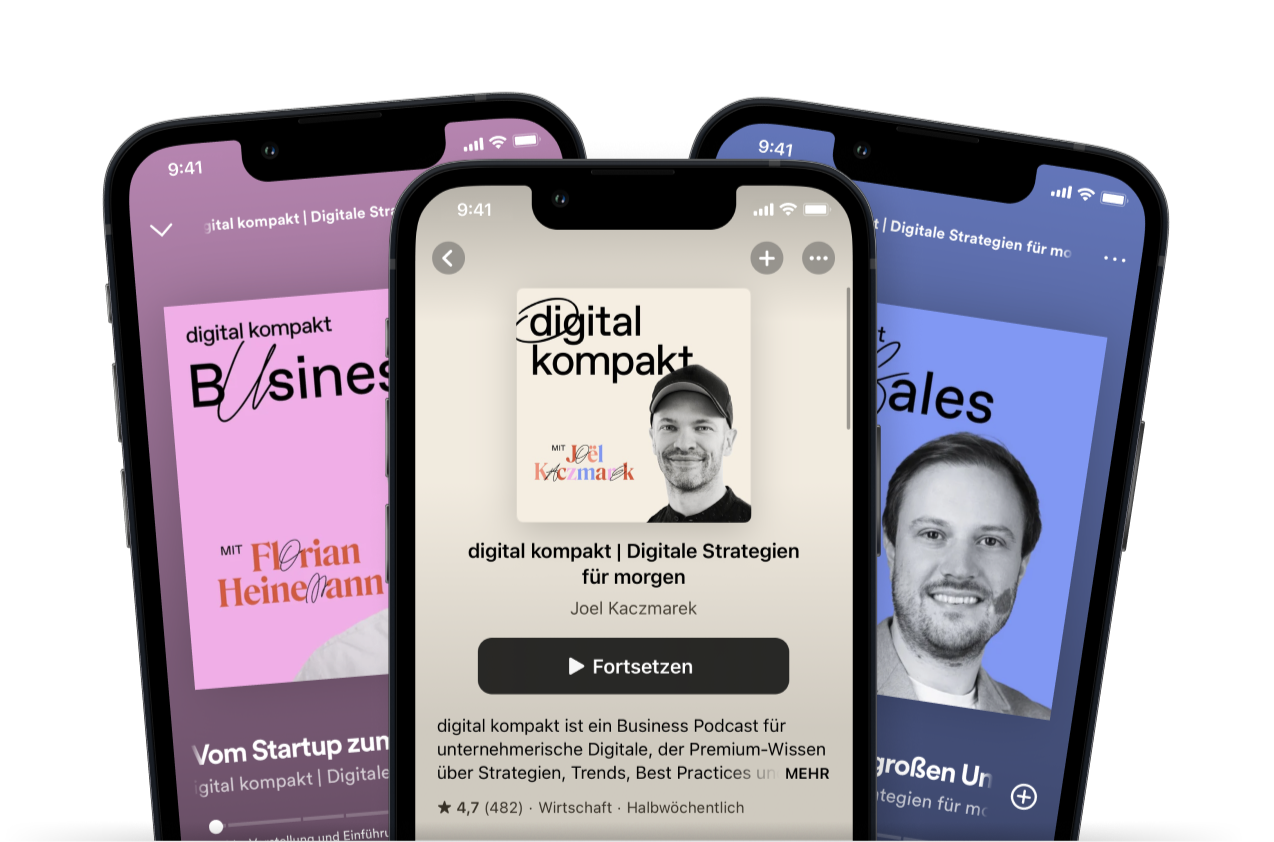
Where are the digital kompakt podcasts published?
On all the usual platforms: Spotify, Apple Podcasts, YouTube, Amazon Music and Deezer. Via the RSS feed our episodes also run in any podcast app you like – Overcast, Pocket Casts, Castro and the rest.
Because your spot is cut permanently into the episode, it runs everywhere along with it. In the video on YouTube too, and also wherever we do not distribute the episode ourselves.
How many listeners or subscribers do you have?
Across all channels 44,000+ subscribers. 3,000+ decision-makers listen to every new episode.
All figures are measured, not estimated – the plays are certified to IAB standard 2.2. The breakdown by channel, the listen-through rate and the audience profile are in the media kit.
Who is the target group?
Decision-makers from the digital economy. 83.8% hold budget responsibility, 67.6% lead people, 64.7% are C-level or founders.
Ninety per cent are between 28 and 59 years old – the years in which budgets are managed. 83% hold a university degree, 69% live in a metropolitan area.
In terms of subject matter the focus is on artificial intelligence, leadership, and sales and growth stories. The full figures, including sources and sample size, are in the media kit.
In which countries do you publish your podcasts?
Our podcast can be received all over the world; our main reach is in the DACH region, with Germany as the clear primary market.
Do I receive a quote from digital kompakt?
Yes, all clients receive a quote with advertising proposals by email.
Should I book directly with you or through a sales house?
Both are possible, and both have their reasons:
- Directly with us you usually get the better terms, the coordination is shorter, and we can accommodate particular requests.
- Through a sales house is worthwhile if you want to book digital kompakt together with other podcasts from a single source.
At what point is the order considered placed?
Either when the quote is signed or when the podcast briefing is submitted.
Can I exclude competitors?
Yes. You name the competitors, and they will not get a placement with us during your booking period.
This costs a surcharge on the package price: 10% for up to three competitors, 15% for up to five.
What is the reach boost?
We additionally promote selected episodes your spot runs in through paid channels – which brings more plays to exactly those episodes.
There are three flat-rate levels: €150, €300 or €500. We plan how the budget is spread across the episodes; you just pick the level.
Is podcast advertising easy to measure?
Honestly: only in part. Podcast advertising is not performance marketing, and anyone who sells it to you as such is selling you something false.
The reason is the media break between podcast app and browser. Most people hear your spot, type your name into a search engine later, and never show up in any statistic as a podcast contact. We reckon that around a fifth can be attributed via tracking URLs and discount codes.
What we measure cleanly: the plays of the episodes your spot ran in – certified to IAB standard 2.2.
What we cannot do: tell you exactly who listened. Your advertising is cut permanently into the episode and does not run through an ad server that tells individual people apart. You will find our audience profile in the media kit instead.
How do you measure the success of your podcast advertising?
We use a range of different measures to assess the effects of our podcast advertising:
- DISCOUNT CODE: If you give us a discount code, we read it out in the advertising, which often encourages listeners to act.
- TRACKING URL: As the URL we always read out a digital kompakt address followed by your company name, e.g. digitalkompakt.de/sevdesk. We can point these redirects at any link you like, so that you can use a web address with UTM parameters and measure the traffic yourself.
- LANDING PAGE: We set up a landing page for you in our sponsors area (which is also read out at the end of the podcast ad) and link from there to the tracking URL.
- POST-PURCHASE SURVEY: We recommend asking your customers at the end of a purchase process on your site how they became aware of the offer, and including “podcast” as one of the possible answers.
- GATED CONTENT: In some cases gated content can be a useful measurement tool, for example if you refer at the end of your advertising to a whitepaper or case study that listeners can download in exchange for their email address.
A typical sign-off to one of our podcast ads then sounds something like this:
“If that is of interest to you, just go to digitalkompakt.de/sevdesk and take a look at the details there. As always, you will find all the information on our sponsors page at digitalkompakt.de/sponsoren.”
Do you work with discount codes?
Yes, that is common practice with us. When you submit your briefing, simply send us the relevant code and let us know what it does, and we will build it into the spot accordingly.
Is there anything to bear in mind with discount codes?
We always recommend two things here. First, the discount code should be easy to remember, for example “kompakt”. Second, it should grant a noticeable but not excessive discount. For instance 10% to 15% can be a good approach, or a free month or extra features.
If the discount is too small, the incentive to enter a code is too weak. If it is too large, it may distort the picture and could be picked up by bargain-hunting sites.
Do you work with landing pages or UTM parameters?
Yes, that is possible. The easiest way is to supply us with your landing page along with the briefing. As a rule we work in such a way that the URL we read out is always a digital kompakt address followed by your company or product name, e.g. digitalkompakt.de/sevdesk.
You can point this redirect at any URL of your own, for example a web address with UTM parameters, so that you can measure the traffic to that URL yourself.
Can I also use more than one landing page?
Technically yes, but we would not recommend it. Two addresses in the same campaign cause more confusion than they deliver insight – and anyone who mixes them up ends up nowhere.
Better: one main address that is the same in every spot, plus a deep link in the show notes, to a whitepaper or a case study for example.
If you really do want to test two variants against each other, talk to us. From the larger packages upwards, with their several ad versions, this can be split cleanly; for the additional work we charge €250 to €350 depending on the scope.
Are there any costs for discount codes or landing pages?
No, in essence the use of these measurement methods is already covered by our podcast prices. Costs only arise for these services under the following circumstances:
- If a discount code is supplied significantly too late or is only requested after the first spots have been published – in this case a handling fee of €150 is charged
- If more than one URL or several discount codes are to be used in different spots – this too is charged with a handling fee of €150 to €200, depending on the scope
Is there a report afterwards?
Yes. After the last placement you receive a report, and we go through it together in a short call. It contains the plays of each episode, for example.
What it does not contain is the gender and age of the people who heard your spot. Permanently embedded advertising runs without an ad server that could break this down per campaign. You will find our audience profile in the media kit instead.
Can you also include POs or order numbers?
Yes, that is possible at any time. We know the burning hoops our clients are often expected to jump through for their accounting departments, and we are always happy to help – provided we know about it in good time.
When is the invoice issued?
From the point at which digital kompakt incurs costs, so as a rule once the ad material has been produced – in other words, once the ad spot has been recorded, a lovingly designed invoice lands on your desk.
What are your payment terms?
Our payment term is 14 days from receipt of invoice.
Newsletter
Stay in  ouch
ouch
Once a week, the strongest learnings, honest and to the point – free in your inbox.
Subscribe to the newsletter